Generative Audit Compliance for Elm AI
ELM AI is an enterprise SaaS platform helping SMBs manage ESG compliance — using AI to analyze audits, detect non-compliance, and generate corrective action plans.
DURATION
5 Months
ROLE
Product Designer
TEAM
3 Engineers, 1 Designer
TOOLS
Figma
The Problem
SMBs spend 20–30 hours weekly on manual ESG compliance tasks, causing 40% reporting delays and 15–20% error rates.
While SMBs collect valuable audit data, it’s often fragmented across reports, lacks clear prioritization, and non-compliance items can get missed — creating key challenges for compliance management.



User Research
How might we help SMBs centralize non‑compliance data, understand supplier risk, and streamline corrective actions?
Fragmented audit data, low supplier-risk visibility, and manual corrective actions were slowing compliance decisions. To ground a centralized dashboard concept, I interviewed SMB users about their workflows and audit challenges.

SMB User / Compliance Manager
“I have multiple audits coming in from different suppliers, and it’s hard to keep track of all the non-compliance items without digging through several PDFs.”
Insight: SMBs need centralized visibility into non-compliance items across all audits.

SMB User / Operations Lead
“I want to see which suppliers pose the most risk at a glance, instead of piecing together their history from scattered reports.”
Insight: Supplier risk needs to be legible at a glance, not pieced together from scattered reports.
SMB User / Quality Auditor
“Resolving findings takes forever — corrective actions are manual and easy to lose track of, so decisions keep slipping.”
Insight: Corrective actions need to be streamlined and tracked in one place.
Defining
Framing the problem, hypothesis, and user story.
Problem Statement
“As a compliance manager, I juggle audits from many suppliers. Without clear prioritization, non-compliance items get missed and reporting falls behind.”
Hypothesis Statement
“With AI-generated insights and corrective actions, SMBs can centralize compliance data and resolve issues faster and with more confidence.”
User Statement
“I need one place to track non-compliance items, understand supplier risk, and act on corrective steps — without digging through PDFs.”
Process
Research
How are SMBs currently managing their compliance tasks?
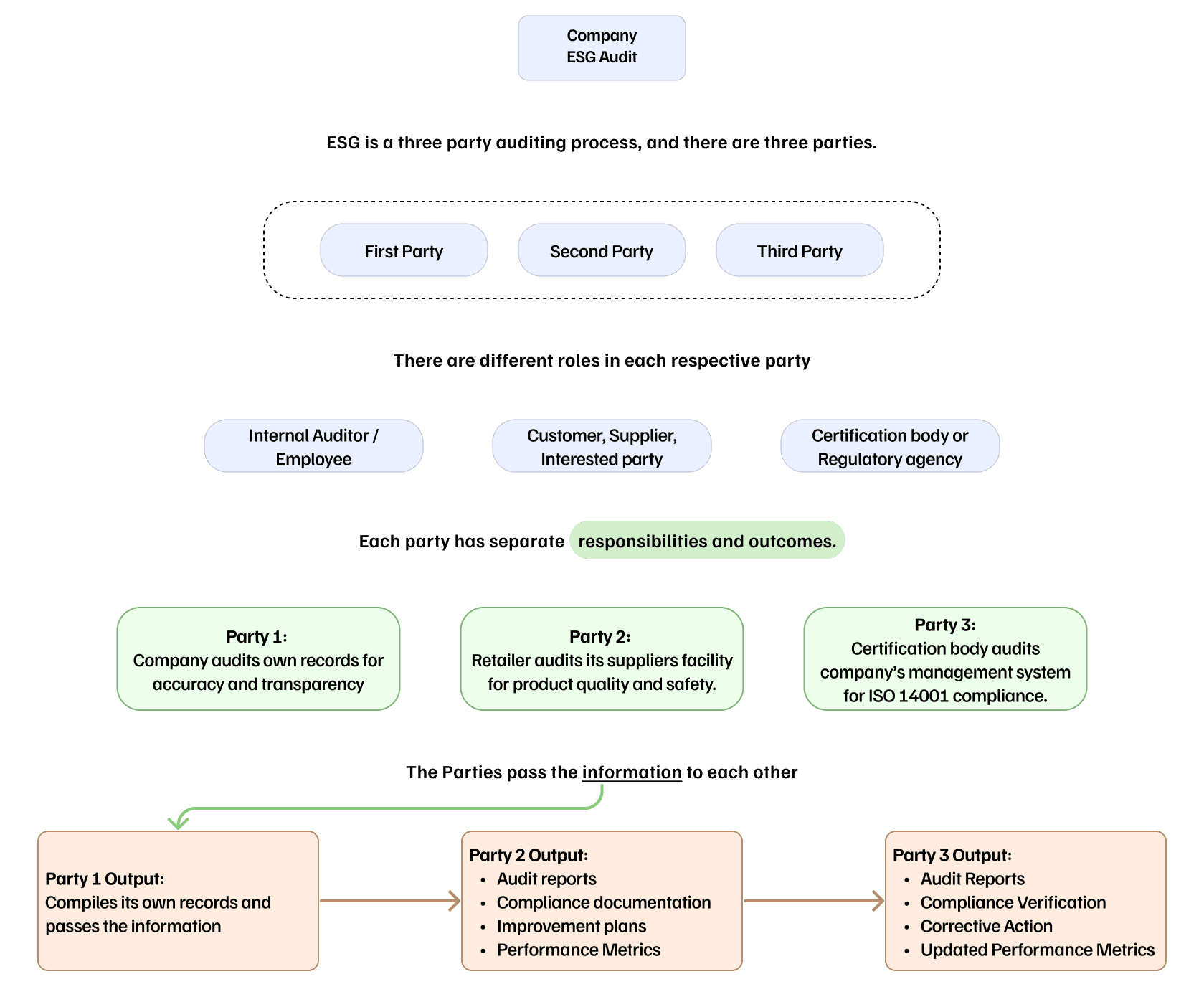
To better understand how SMBs manage ESG due‑diligence tasks, we collected user insights and translated them into a detailed journey map of the auditing company’s process. This allowed us to visualize each step, pinpoint where errors occur, and identify opportunities for design intervention early in the process.
Guiding the Ideation
I led a brainstorming session with my team of 3 engineers and product manager to ideate possible features, making sure to reference our essential HMW statement. Below is an overview of our main brainstorming results.
01
How might we centralize non‑compliance data across audits?
02
How might we make supplier risk visible at a glance?
03
How might we streamline corrective actions end to end?
Centralizing and simplifying the findings
Unified Audit View
Combine all audit PDFs into a single dashboard showing non-compliance items in a sortable table.
david park
Quick Prioritization Tags
Add tags like “High Risk,” “Critical,” or “Low Priority” to help users triage faster.
david park
Search & Filter
Enable filtering by supplier, audit date, or risk category for easy navigation.
david park
Visualizing where the errors are and the severity
Risk Scoring System
Display an overall risk score for each supplier based on historical compliance trends.
david park
Timeline View
Visualize a supplier’s compliance history over time to spot patterns.
david park
Audit Error Detections
Visualizing where the non-conformances have been detected in the audited reports.
david park
Actions SMBs can take
Follow-up Nudges
Point out reminders to suppliers with outstanding corrective actions.
david park
Action Tracking
Show a checklist of unresolved vs. resolved issues per supplier.
david park
Corrective Planning
Actions SMBs can take towards the errors detected, more insights.
david park
The Solution
An AI-driven solution that flags audit issues with summarized action plans.
Report Roll-ups
Combines uploaded audits into one view, surfacing ESG categories and detected compliance issues.
Corrective Action Plan
AI-generated corrective actions for each flagged issue — a starting point users can customize and complete.
Supplier Score Card
A high-level view of supplier performance over time, spotting recurring critical compliance issues.
01
Create Transparency
Supplier receives an invitation to conduct an audit, passing audited PDFs prior to second- or first-party reports.
02
Data Processing
Certifies that the business complies with external standards, regulations, and laws — following the suggested framework so stakeholders stay informed.
03
Insights
The LLM cross-references extracted data from supplier reports against the selected framework(s), providing instant compliance guidance and highlighting non-conformance.
04
Corrective Action Plans
The tool generates scenarios and outcomes for corrective strategies; users select the most suitable plans based on AI-generated insights.
05
Suppliers Profile
Users iterate through each supplier’s profile dashboard to see updated insights and continuous adherence to standards.
Iteration
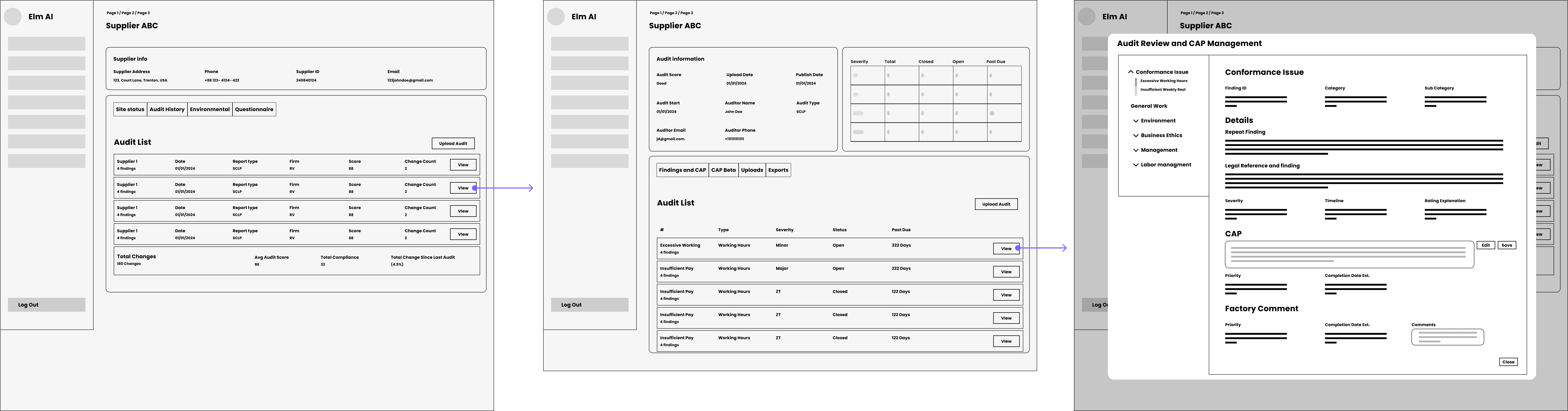
From sketches to low-fidelity explorations.
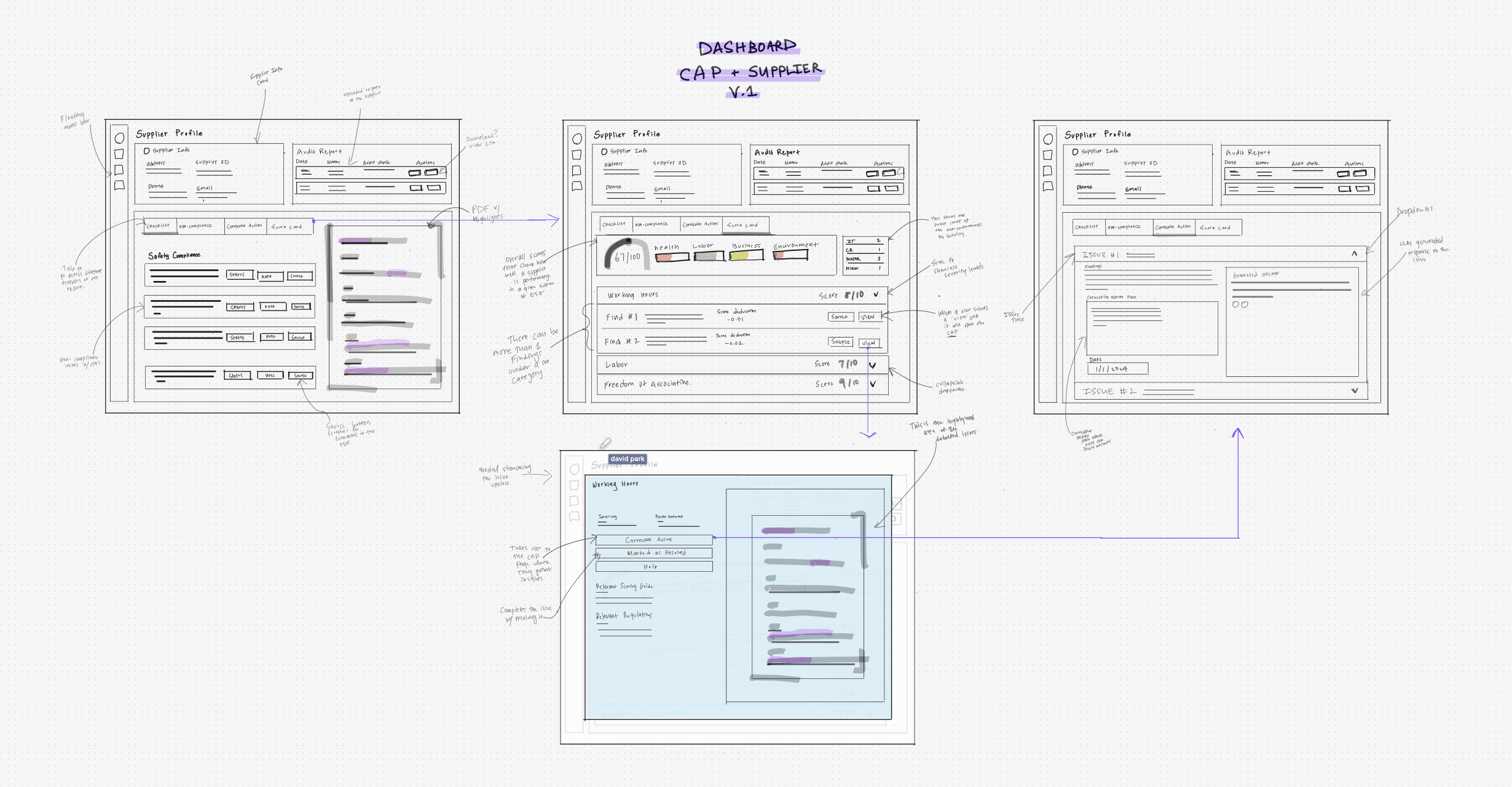
During this process, I worked closely with developers to understand the constraints of our LLM models, which helped shape a realistic user flow for how SMBs would engage with the Corrective Action Plan (CAP) feature. With these insights, I moved into early low-fidelity sketching to map out key interaction points across the product.
Usability Test
Early testing across the three low-fidelity screens.
I tested the low-fidelity flows with users to understand what worked and what didn’t. While some interactions supported quick task completion, testing surfaced navigation and density issues across all three screens.
Home Page / Report Roll-ups
Users could upload or select past reports, then access insights and corrective actions with minimal friction — simplifying access to non-compliance findings while emphasizing next steps.
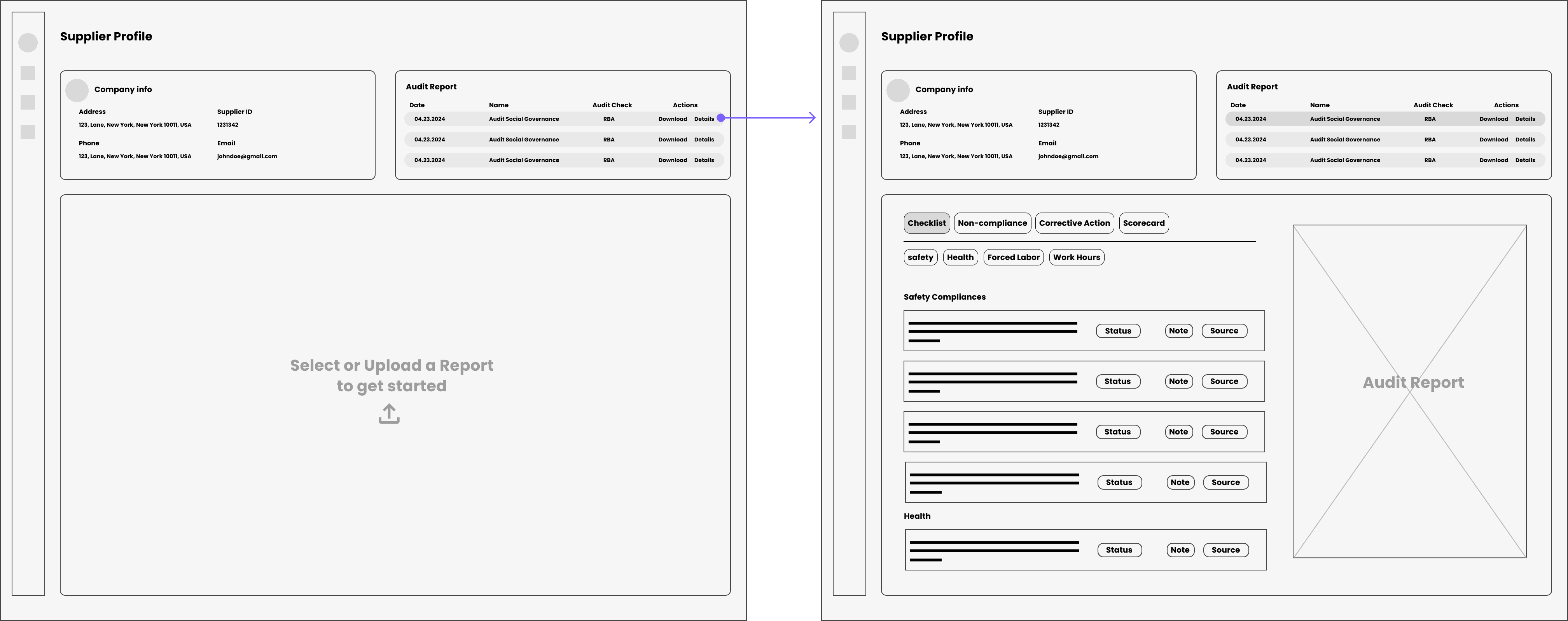
+ Quick report selection to begin viewing
+ Simple access to non-compliance findings
− Tab navigation feels non-intuitive next to pill-shaped categories
− Navigating between suppliers feels confusing
− Visually dense, with multiple paragraphs to read
CAP / AI Corrective Actions
For each issue flagged in the audit, an AI-generated corrective action is surfaced, giving users a starting point to customize and complete their response efficiently.
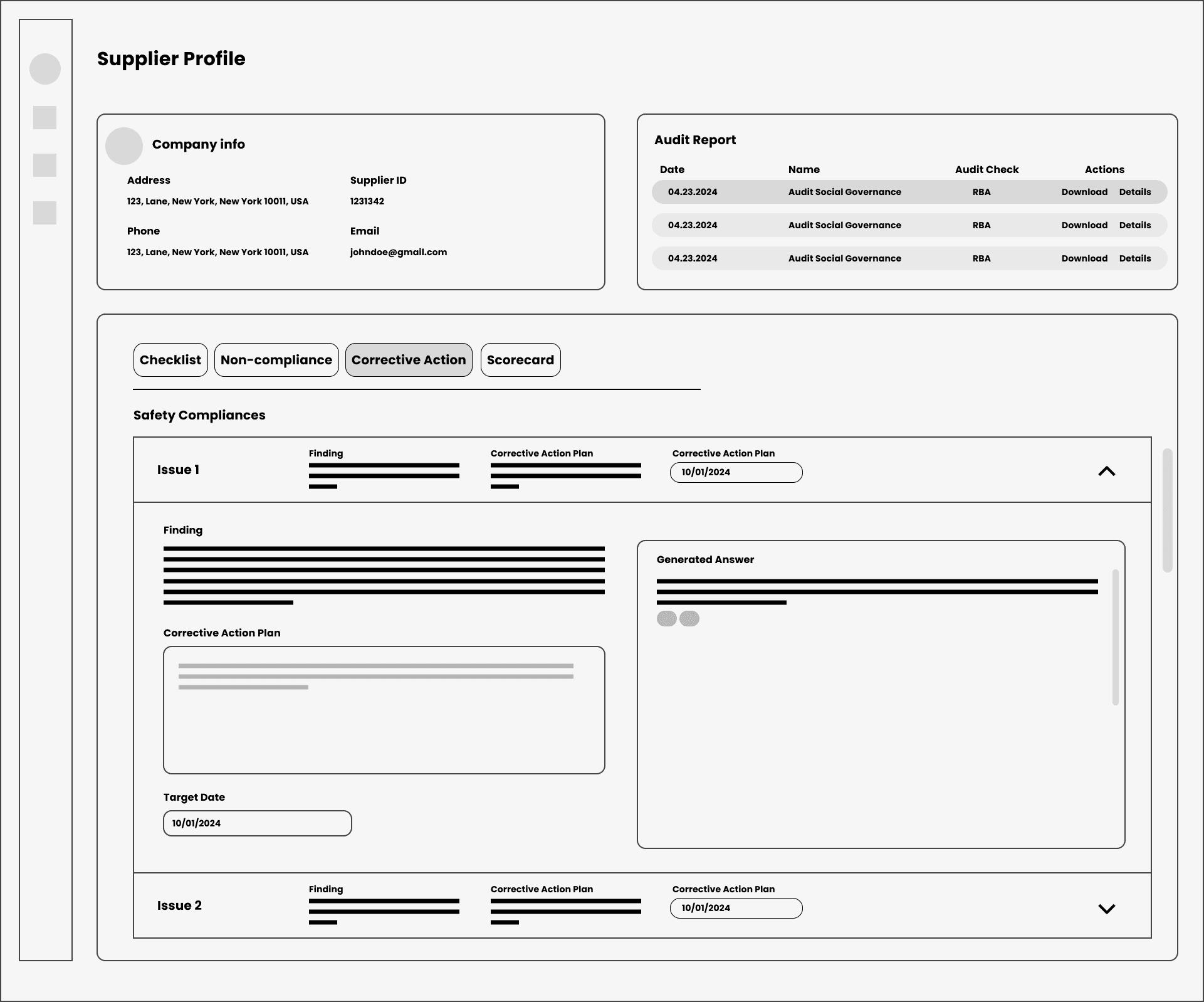
+ Supports quick drafting of next steps using AI
− Not intuitive to click into the CAP input and expect it to save
− Lacking immediate, high-visibility CTAs
− Redundant issue list items make priorities hard to differentiate
Score Card / Supplier View
This page gives users a high-level view of supplier performance over time, making it easy to spot recurring critical compliance issues across multiple reports.
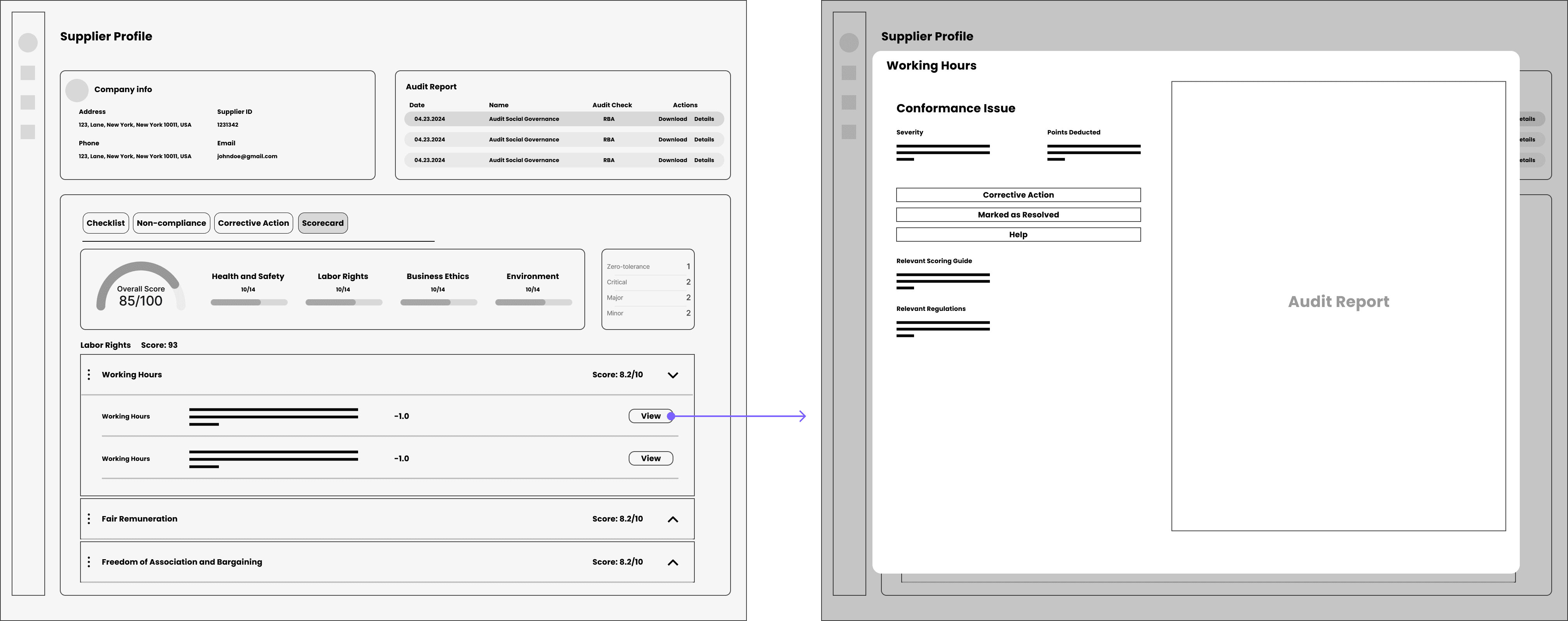
+ Easy to assess how well a supplier is performing
+ Recurring critical issues are visible across reports
− Repetitive modal popups increase distraction
Results
User testing proved we needed to pivot.
After conducting several usability tests, the tab navigation between each feature seemed purposeful to users, they lacked enough distinction from each other, and users felt parts of the screens like the compliance issue items were redundant. This made it difficult for users to know where to navigate and what mattered most for their tasks — so I pivoted the design in a different direction.
What Worked
+ Tab navigation between features felt purposeful
+ AI-generated actions gave users a clear starting point
+ High relevance for weekly compliance tasks
What Didn’t
− Tabs lacked enough distinction from each other
− Compliance issue items felt redundant across screens
− Users struggled to know where to navigate for their task
New Design
A unified dashboard that keeps the audit features all in one tab.
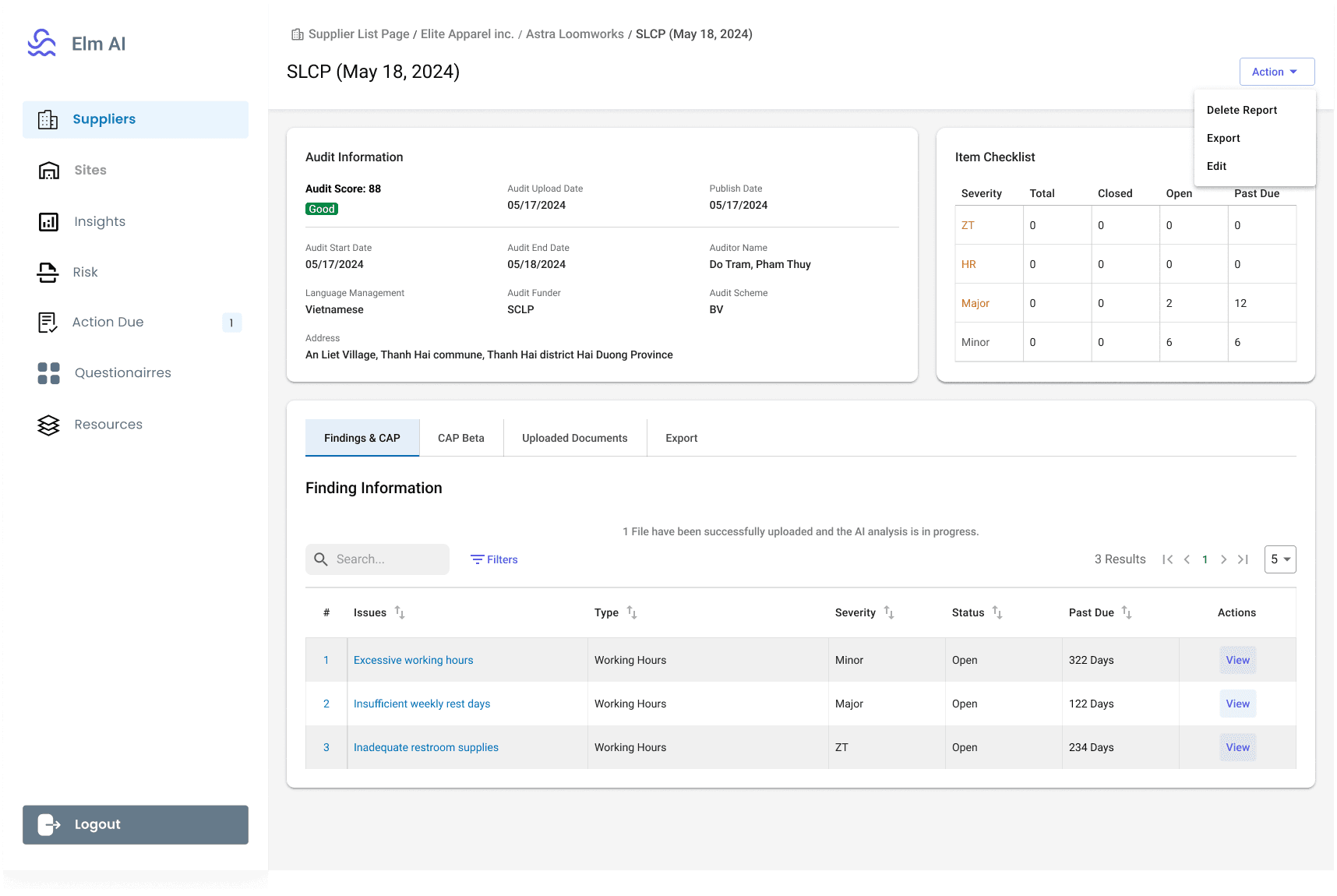
After aligning with engineering, we restructured the system architecture to clarify the purpose of each tab and reduce redundancy. We grouped all audit-related insights under a single Audit History tab, moved the report overview to the forefront, and let users drill into conformance items via a modal rather than navigating away.
Final Delivery
Final designs across the core flow.
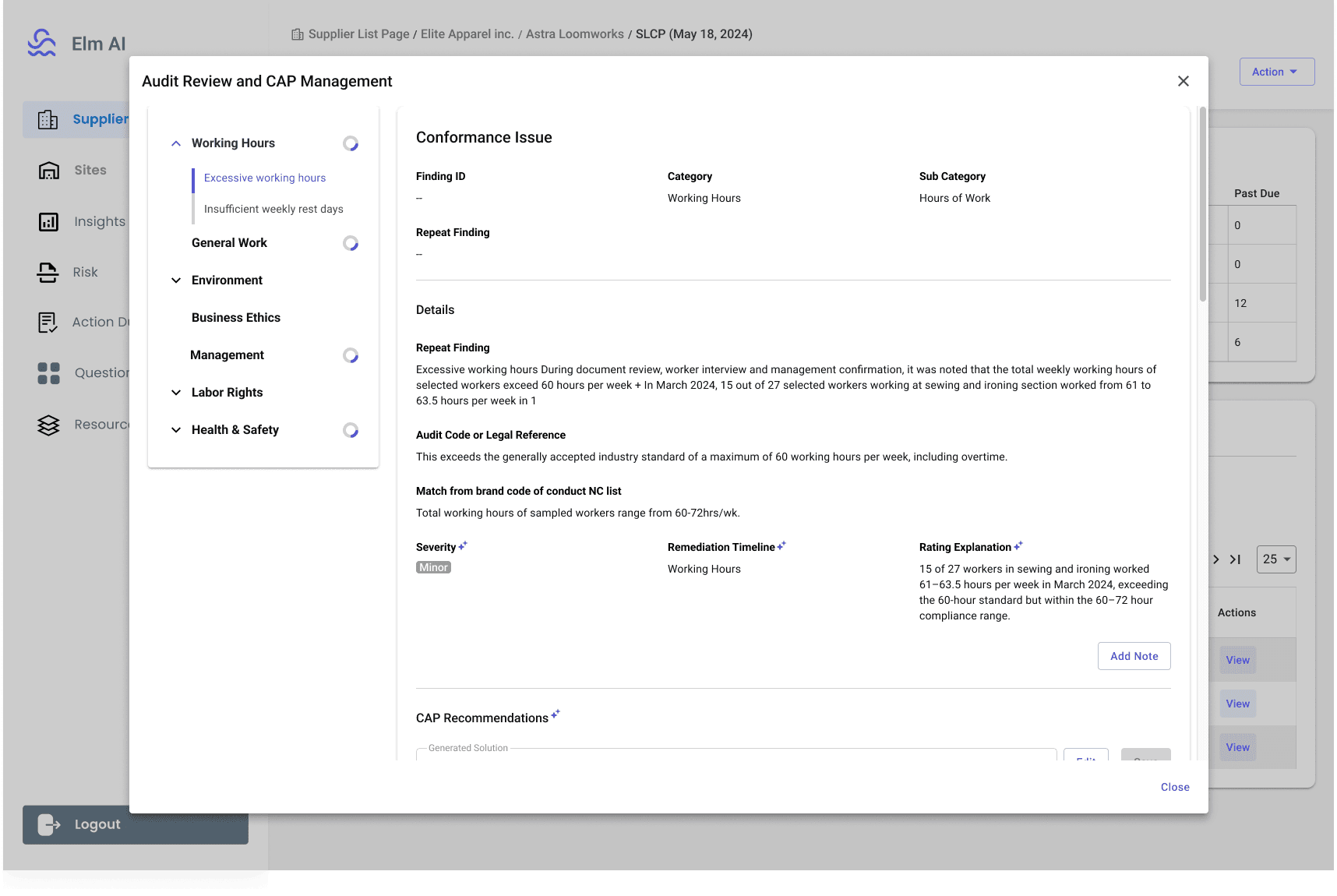
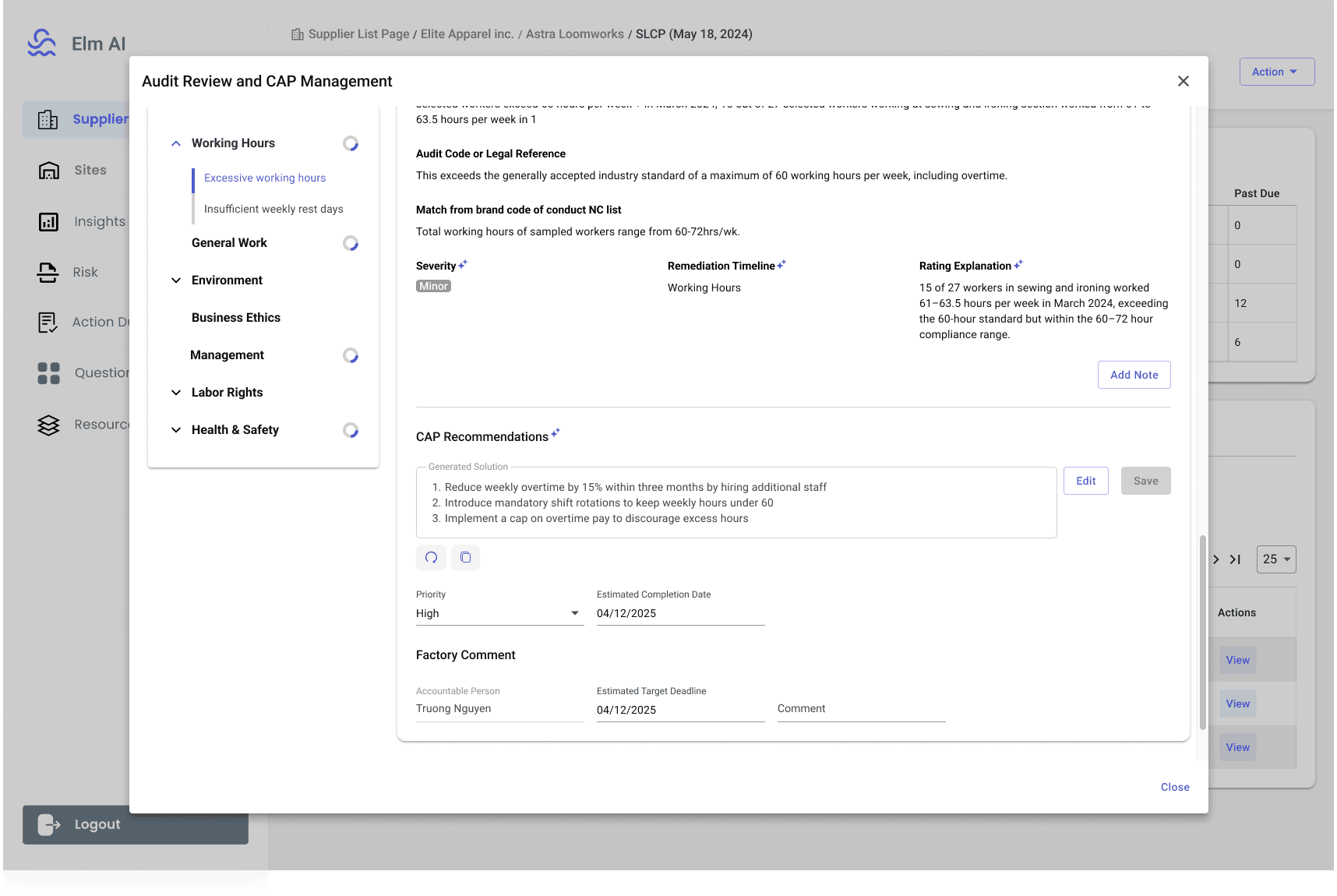
The final designs bring the experience together across three levels — Home / Supplier, Supplier / Report, and Report / CAP — keeping audit insights and corrective actions in one place.
Home / supplier

Home / supplier / report
Home / supplier / report / cap
Continued Usability Testing
Run continued usability testing on the revised report entry flow to evaluate whether the new navigation and report selection experience is clear and reduces redundancy — and whether the dashboard scales for future features.
Enhanced CAP Resolution
Expand the CAP feature by leveraging AI to deliver more tailored recommendations — auto-prioritizing critical non-compliances and compiling supplier-facing plans that encourage long-term accountability.
Scaling With AI
Partner with engineering as LLM capabilities mature to expand automated detection across more ESG standards and regulations.
Ending Notes
Reflections
Designing for validation in a lean startup.
In the early stages of ELM AI, we faced the familiar challenges of a lean startup — tight timelines, limited budget, and the pressure to validate quickly. Rather than investing in a mature design system, we focused on delivering core value through our LLM capabilities. Rapid prototyping and constant iteration with SMBs shaped our priorities and helped us build a product that addressed real-world ESG compliance challenges from day one.
←
Return back home
©2026 David Park
| Made with love in NYC
Thanks for being here.